

Parameters let you create reusable workflows that accept different input values each time they run. Instead of hardcoding a URL or search term into a block, you reference a parameter and fill in the value when you run the workflow. This page covers parameters in the Cloud UI workflow editor. If you’re building automations in code, parameters are just function arguments. See Browser Automation for the code-first approach.Documentation Index
Fetch the complete documentation index at: https://skyvern.com/docs/llms.txt
Use this file to discover all available pages before exploring further.
Opening the parameters panel
In the workflow editor, click the Parameters button in the header bar. A panel appears below the header showing all defined parameters and controls to add new ones.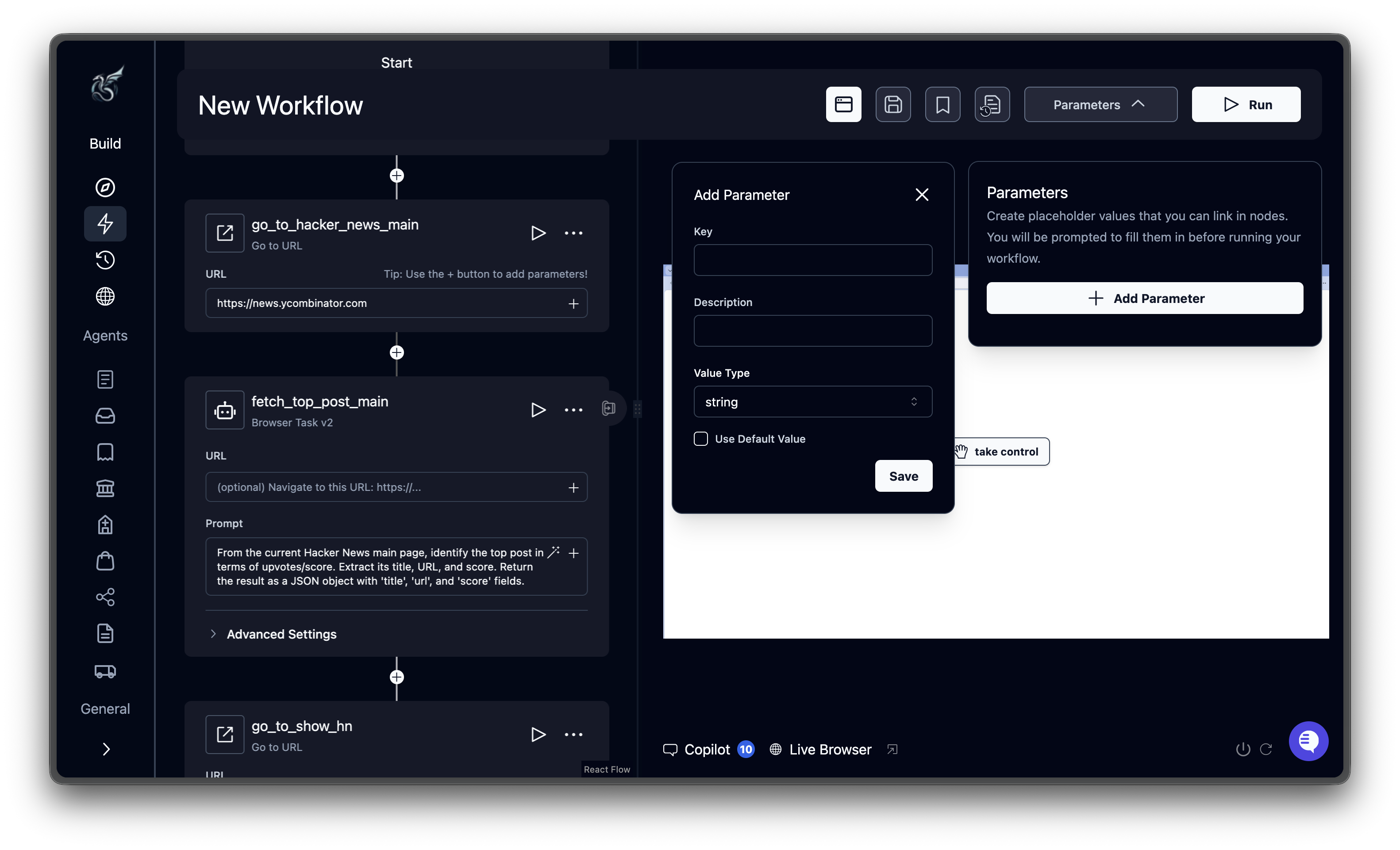
Adding a parameter
Click Add Parameter in the panel. Two types are available:| Type | Use for |
|---|---|
| Input Parameter | Values the user provides when running the workflow (text, numbers, JSON, etc.) |
| Credential Parameter | Securely inject login credentials from a vault (Bitwarden, 1Password, Azure, AWS, or Skyvern) |
Parameter value types
Input parameters support these value types:| Type | Input control | Example |
|---|---|---|
| String | Text field | "https://example.com" |
| Integer | Number field | 10 |
| Float | Number field | 19.99 |
| Boolean | Toggle switch | true |
| JSON | Code editor | {"key": "value"} |
| File URL | Text field (paste a URL) | "https://example.com/data.csv" |
| Credential ID | Dropdown selector (shown at runtime) | Selected from stored credentials |
Referencing parameters in blocks
Use Jinja2 double-brace syntax to reference parameters inside block fields like prompts, URLs, and data schemas. Basic reference:Credential parameters
Credential parameters securely inject login credentials into blocks without exposing them in prompts or logs.| Source | What it provides |
|---|---|
| Skyvern Credential | Username and password stored on the Skyvern Credentials page |
| Bitwarden Login | Username, password, and optional TOTP from your Bitwarden vault |
| Bitwarden Credit Card | Card number, holder name, expiry, and CVV from Bitwarden |
| Bitwarden Sensitive Information | Sensitive data fields from Bitwarden |
| 1Password | Username, password, card data, or TOTP from 1Password |
| Azure Key Vault | Secrets stored in Azure Key Vault |
| AWS Secret | Secrets stored in AWS Secrets Manager |
| Azure Secret | Secrets stored in Azure Secret |
Output parameters
Every block automatically produces an output parameter containing its results. You can reference a previous block’s output in any downstream block. The syntax uses the block’s label (lowercased, spaces replaced with underscores) followed by_output:
Reserved variables
These variable names are built-in and cannot be used as parameter keys:| Variable | Available in | Description |
|---|---|---|
current_value | Loop blocks | The current item being iterated |
current_item | Loop blocks | Alias for current_value |
current_index | Loop blocks | Zero-based index of the current iteration |
workflow_run_id | All blocks | Unique ID of the current run |
workflow_id | All blocks | The workflow’s ID |
workflow_permanent_id | All blocks | The workflow’s permanent ID |
workflow_title | All blocks | The workflow’s title |
What’s next
Block Reference
Configuration fields for every block type
Run Your Workflow
Execute workflows and fill in parameter values